

Metricooler, Apple wiped its entire TikTok account.
Zero posts, counter back to zero, and a brand new strategy from scratch. Where there used to be flawless videos with no logo in sight (because you didn't need one, you already knew it was Apple), there are now colorful carousels, product front and center, and Gen Z setting the tone. The comments range from celebration to disbelief:
"Is Apple fun again?"

Because yes, let's not forget what Apple used to look like:


Fun and colorful, the nemesis to beige and boring computing. But over the years, they became exactly what they were fighting against, just with a metallic sheen over the grey:

This move is turning heads, but not because it's unusual for a brand to adapt its tone for TikTok. Duolingo, Ryanair, and Heinz figured that out years ago. What makes this news is who's doing it. Until now, Apple was the last major example of a brand that kept its identity intact no matter where it showed up: the clean aesthetic, the restraint, the calculated silence. A wall that seemed unmovable.
And they moved it.
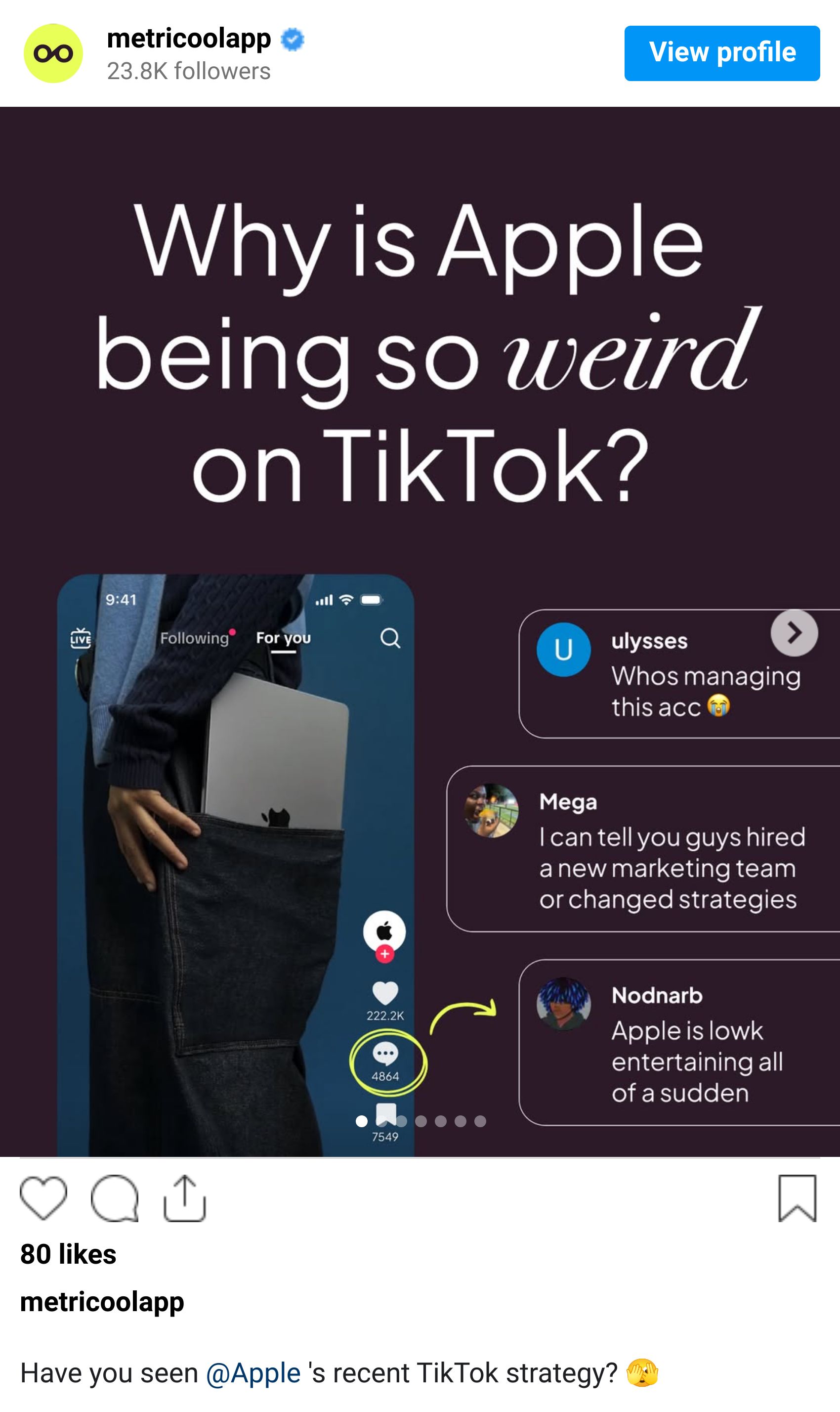
The fact that Apple is adapting to TikTok's logic says something about where social media is right now. Having a strong brand identity isn't enough anymore; you have to decide how to use it on each platform.
Apples and strategies
Should every brand do what Apple did? No.
And most couldn't even if they wanted to. But every brand does need to make a decision about how they show up across different channels, because not deciding is also a strategy (and it's rarely a good one).
There are basically three ways to go about it:
#1. Post the same content across all channels
Everything is published everywhere, and most of the time, it’s the exact same content. Same images, same copy, same everything. That's what Target and Scrub Daddy do, among others.
The upside is clear: one piece of content covers multiple channels, brand identity stays consistent, and scheduling becomes much simpler.
The downside is that every platform has its own logic, its own algorithm, and its own audience, and content that wasn't built for a specific channel rarely performs as well as content that was.
A good example of this approach is soda brand Poppi, which posts the same content across all its channels without changing a word:

#2. Adapt without reinventing
Same idea, same message, but with adjustments. Copy gets tweaked, format changes, and length gets cut or stretched depending on the channel. Penguin Random House, Dunkin' Donuts, and Gymshark work this way, and so do we at Metricool.
It's probably the most common approach because it strikes a reasonable balance between efficiency and performance. The risk is that if the adjustments are too surface-level, people who follow you on multiple channels end up seeing slight variations of the same content and stop paying attention.
Disney+ is a good example here. On TikTok, it's The Simpsons, on Instagram, it's Daredevil, but 50% of their last 15 posts were literally identical across both platforms.

#3. Build a distinct personality for each platform
This is what Apple just did, and what Adidas, Sephora, and Beyond Meat have been doing for years. Not just adapting the format, but the tone, the type of content, and the relationship with the audience.
It's the approach that gets the most out of each channel and builds the most loyalty, because it gives people a real reason to follow you in more than one place. It's also the most expensive in terms of time, money, and execution, and the one most likely to go wrong if there's no clear thinking behind each decision.
In Apple's case, they literally created a brand new Instagram account, @helloapple, specifically for this more TikTok-style content.
So which strategy is right?
None of them and all of them. It depends on your team, your budget, and most importantly, where your audience is and how they behave.
The most important thing is to identify the channel that's working best for you and put the bulk of your energy and resources there. From there, you decide what to do with the rest; whether you post the same thing, adapt it, or build something new, but with a clear rationale and a realistic sense of what each option actually costs you.
The most common mistake isn't choosing the wrong strategy, it's not choosing any strategy at all and ending up spread across five channels at half effort, with no real sense of what's working and what isn't. You end up pulling resources away from the channel that's actually delivering results to put them into channels where the return is unclear.
My recommendation, of course: Metricool. One place to track performance across all your channels, compare how the same content lands on different platforms, and decide where to focus without having ten tabs open at once.
Want more newsletters about strategy?
SUBSCRIBE NOW
Join 60,000 marketing professionals and receive this newsletter in your inbox every week
THIS WEEK’S STORIES
Are clickable links finally coming to Instagram?
The platform is testing clickable links directly in post captions. The catch: it's only available to Meta Verified users, with a limit of 4 uses per month.
If this rolls out properly, it would be a significant change for anyone creating content on social media. In the meantime, check out our SmartLinks, a simple but powerful way to create a custom page with all your most important links, and one that works across any social network. Our own social team actually uses a different one for each platform.
Plus…
How to Leverage LinkedIn for AI Visibility in 2026.
Google Tests Instagram Knowledge Panel Design.
New tools in Edits, including freeze frame.
Instagram to discontinue end-to-end encryption for DMs.
LinkedIn is working on a new algorithm that shows less generic and engagement-bait content.
TRY THIS
It’s not stalking, it’s benchmarking

When you're not sure where to start with your strategy, a good first step is to see what everyone else is doing.
Track other brands and businesses in Metricool and analyze which content is working best for them. Add the accounts you want to track, pull up their key metrics, and use what you find to make better decisions for your own channels.
PS
Michael B. Jordan, fresh off his Best Actor win for Sinners, celebrated by going straight to In-N-Out for a burger. A proper tradition.
Celebrating a win that way is a great idea, so: what's your post-viral-post meal? Mine is a cheese pizza, the kind where the cheese stretches forever, and a Coke. Unbeatable 💛
EVERGREEN ESSENTIALS
Free template
Plan weeks of content in just one hour →
Marketing Calendar 2026
Over 200 key dates and celebrations so you never run out of content ideas again →
Social Media Study 2026
We analyzed 39 million posts to uncover the trends and formats that truly perform →
Learn Metricool
Mega guide to discover and master every Metricool feature →
ENJOYED THIS EMAIL?
If you’ve made it all the way to the bottom of this email, first, you're the best. Second, I’d love to hear your feedback so I can keep making these emails as valuable (and enjoyable) as possible:
😍 Loved it - 👍 Pretty good - 🤔 It was okay - ☹️ I didn’t like it